

A Kenyan pilot has revealed details of a secret and politically sensitive mission carried out in 1995 to transport the body of Somalia’s former president, Siad Barre, from Nigeria back to Somalia for burial.
According to a report by the BBC World Service, the covert operation involved multiple African countries, disguised flight plans, and high-level diplomatic coordination, all carried out under extreme secrecy.
A Diplomatic Request That Changed Everything
Exactly 31 years ago, two Kenyan pilots—Hussein Mohamed Anshuur and Mohamed Adan, partners at Bluebird Aviation—received an unexpected visit at Wilson Airport in Nairobi. A Nigerian diplomat approached them with a delicate request: to secretly fly the body of Siad Barre from Lagos, Nigeria, to his hometown Garbaharey in southern Somalia.
Siad Barre, who ruled Somalia for over two decades, had died in exile in Nigeria at the age of 80, four years after being overthrown and forced out of Somalia in 1991.
“We knew immediately this wasn’t a normal charter,” Anshuur told the BBC.
Why the Mission Was Risky
Returning Barre’s body was politically sensitive. His rule remains controversial—supporters remember him as a pan-Africanist who opposed apartheid, while critics accuse him of widespread human rights abuses.
At the time, Somalia was unstable, and Kenya’s government under President Daniel arap Moi could have faced diplomatic consequences if the mission became public.
“If Kenyan authorities found out, it could have caused serious problems,” Anshuur said.
Despite a lucrative financial offer, the pilots hesitated. They initially advised Nigeria to use a military aircraft, but Nigerian officials rejected the idea, citing runway limitations in Garbaharey and the need for discretion.
Siad Barre’s son, Ayaanle Mohamed Siad Barre, also speaking to the BBC for the first time, said the secrecy was not meant to hide wrongdoing.
“Islamic tradition requires burial as soon as possible,” he explained. “Time was against us.”
He added that while some governments were aware of the plan, going through full diplomatic paperwork would have caused unacceptable delays.
How the Secret Flight Was Executed
The pilots agreed to proceed—on strict conditions. Nigeria would take full responsibility if anything went wrong, and two Nigerian embassy officials would be onboard.
On 11 January 1995, their small aircraft, a Beechcraft King Air B200, took off from Nairobi, officially filing Kisumu as the destination. In reality, the pilots switched off radar tracking mid-flight and diverted to Entebbe, Uganda.
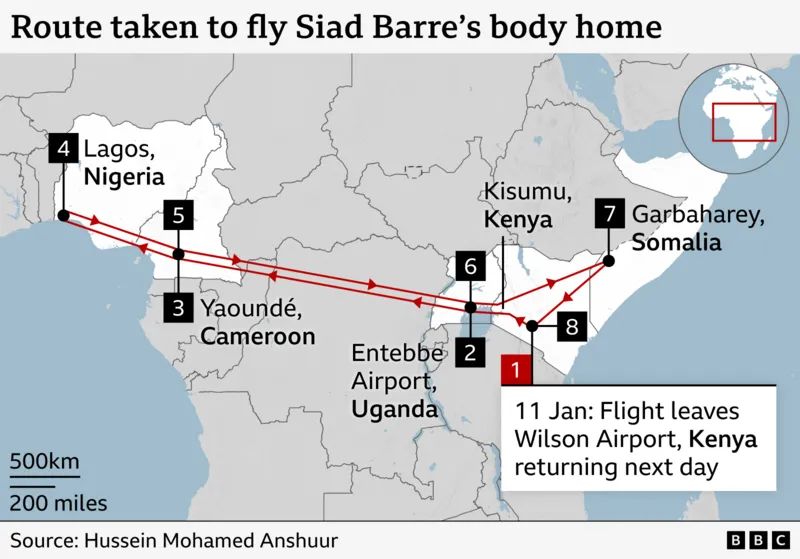
From there, they flew to Yaoundé, Cameroon, and finally to Lagos, using a Nigerian Air Force call sign to avoid suspicion.
The following day, Siad Barre’s wooden casket was loaded onto the plane alongside Nigerian officials and family members. The aircraft retraced its route before diverting directly to Garbaharey, where Barre was buried.
“The Most Stressful Moment”
The final return to Kenya was described as the most nerve-racking part of the mission. To avoid detection, the pilots told Kenyan air traffic control they were arriving from Mandera, making it appear like a routine domestic flight.
“No one asked questions,” Anshuur said. “That’s when we knew we were safe.”
Reflecting decades later, Anshuur said modern aviation technology would make such an operation nearly impossible today.
“Radar coverage across Africa is now much stronger. The gaps we exploited in 1995 no longer exist,” he said.
Would he do it again?
“No,” he answered. “Not today.”
Background: Who Was Siad Barre?
- Seized power in Somalia in 1969 through a military coup
- Ruled for 22 years
- Overthrown in 1991 by militia forces
- Lived in exile in Nigeria until his death in 1995
The issues that many Nigerians kept asking was “what could be Nigeria’s interest in the estranged Somalian leader?”
What was a diplomatic ties between Nigeria and the East African Somalia?
